The official NAVTEX Manual produced by the Swedish Maritime Administration on behalf of the Radiocommunications sub-committee of the International Maritime Organisation, introduces NAVTEX (NAVigational TEleX) as “…an international automated direct-printing service for promulgation of Maritime Safety Information (MSI), navigational and meteorological warnings, meteorological forecasts and other urgent safety-related messages to ships. It was developed to provide a low-cost, simple and automated means of receiving MSI on board ships at sea in coastal waters. The information transmitted may be relevant to all sizes and types of vessel and the selective message-rejection feature ensures that mariners can receive MSI broadcasts which are tailored to their particular needs.“.
NAVTEX DXing is the reception of these MW NAVTEX broadcasts from all over the World. In general, it’s no different to any other DXing activity – searching out far away stations using an appropriately designed and built station, supported by other DXers who provide great DXing tools & advice, and all the while riding the unpredictable propagation waves as you do so. However, chasing NAVTEX DX has two additional (and rather challening or frustrating depending on your point of view) complications that make it quite a bit different in practice.
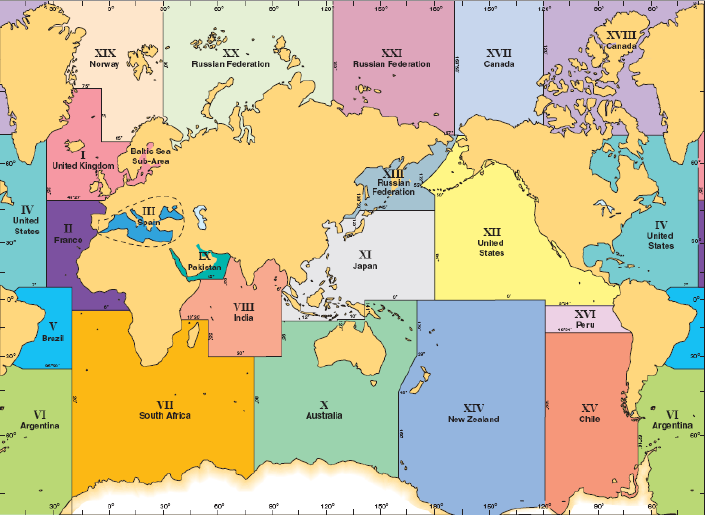
NAVTEX stations Worldwide are organised into 21 geographical areas called “Navareas”. The system employs a global transmission schedule such that one station from each Navarea transmits in each schedule slot. All NAVTEX stations transmit on precisely the same frequency of 518KHz. A separate related network intended for local and regional use operates on 490KHz.
In each time slot there are therefore up to 21 NAVTEX stations transmitting Worldwide on precisely the same frequency and at the same time. You might well ask “Won’t nearby or stronger stations just blot out any weaker stations further away?” Yes they do, and that’s in large part why NAVTEX DXing is so much of a challenge.
The NAVTEX Manual provides a detailed and comprehensive description of the global NAVTEX service. Here I’m only going to talk about the radio and DX reception aspects.
That NAVTEX DXing is possible at all is because of the vagaries of MW propagation. Variations in radio signal paths cause local stations to sometimes be received quite poorly and DX stations sometimes to be received quite well. A key to succcessful NAVTEX DXing is to be listening when these two phenomena coincide. The subject of propagation at MW frequencies is a life’s work in itself. In due course, I’ll write a bit about that subject as it’s a fascinating one but for now, you can get a sense of it here.
Critical to NAVTEX DXing success is a very good MW receiving station. How to build a capable MW receiving station is a topic that would take quite some time to even summarise. I intend writing about that subject in due course but for now I include a number of useful tips later in this article that should help anyone starting out. Also important for NAVTEX DX success is your geographical location relative to the locations of the NAVTEX stations. Unfortunately, that’s not something most of us have any control over most of the time. The MW noise environment as heard by your receiver also plays a big role. To top all that, persistence is needed.
All serious NAVTEX DXers monitor the NAVTEX frequencies all night, every night and all year around as the right conditions only occur occasionally and so the DX only makes it through occasionally. When it does however, it brings a great feeling of achievement with it, every time!
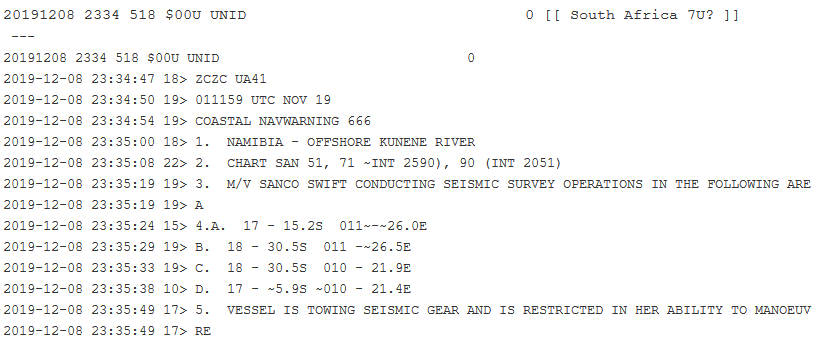
The elements of a Navtex receiving system are as follows:
- An effective antenna for MW frequencies
- A sensitive, selective SSB receiver covering the 490-518KHz frequency range
- An audio feed from that receiver to your PC
- Navtex decoding and logging software
In my case, my setup is as follows:
- A homebrew, SMD based PA0RDT mini-whip active receive antenna.
- A modified↗ Airspy HF+ SDR receiver working with either SDR Console or SDR#.
- I feed the audio from the SDR software to the Navtex decoding and logging software using virtual audio cable software.
- The excellent YAND (Yet Another Navtex Decoder) Navtex decoding and logging software by Dirk Claessens The latest software is available on the NavtexDX list.
Over the last two years I’ve done quite a bit of Navtex DXing and tried a number of different setups e.g. using an inverted L for 80/160M, a K9AY or a mini-whip as antenna, and a Yaesu FT2000, SDR Play or Airspy HF+ as receiver. The current system as summarised above has been the best performer by far. The FT2000 isn’t bad on MW, the SDRPlay is poor as it suffers from significant overload from the adjacent MW broadcast band. The inverted L is a good antenna for Navtex though a bit noisy. The mini-whip is a very special antenna that works extremely well on VLF, LF, MW and MF frequencies in particular. It’s become a firm favourite of mine due consistent high performance for VLF/LF, Navtex and NDB dxing.
I won’t say much about the YAND decoding and logging sofware other than it’s very effective, easy to use and does everything a serious Navtex DXer needs. In terms of logging and reporting, YAND makes the logging piece a breeze and Navtex DXers post daily reports on the NavtexDX list. I recommend you join that list as it’s where the collective knowledge resides and the members of the group are a great bunch of very helpful and extremely knowledgeable people.
As I’ve outlined in another piece on NDB DXing, a good MW frequency receiving station is a life’s work in itself. If you want to have a capable Navtex DX station then you’ll need to put the effort into achieving a performing MW receive system. After that it’s persistence and patience…